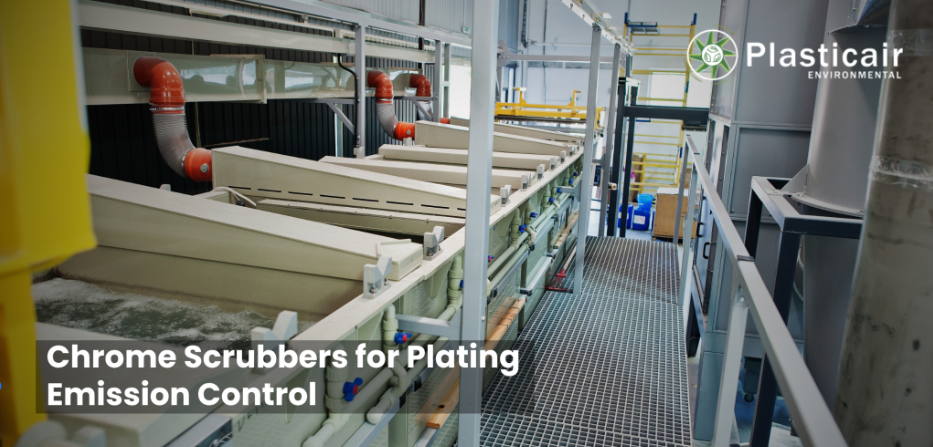
Chrome Scrubbers for Plating Emission Control
A chrome plating line can look perfectly clean from the shop floor while the air above the tanks carries something far more hazardous than it appears. The mist rising from a chromic acid bath contains hexavalent chromium, and keeping it out of workers' lungs and out of the surrounding neighborhood is the job of chrome scrubbers and the exhaust system built around them.
Rather than looking at the scrubber in isolation, this guide follows the exhaust from the plating tank to the stack, showing what happens at each stage and which decisions matter most for chrome plating emission control.
At the Tank: Where the Mist Comes From
Plating baths don't only deposit metal. The current driving the process also releases hydrogen and oxygen gas, and those bubbles rise to the surface and burst, throwing a fine spray of chromic acid into the air above the tank. That airborne mist carries hexavalent chromium, a form of the metal recognized as a human carcinogen when inhaled. Many shops add fume suppressants to the bath to reduce how much mist forms, which helps, but suppressants reduce the problem rather than remove it.
At the Hood: Capturing the Mist
Everything downstream depends on how well the mist is captured in the first place. Hoods positioned along the tank draw rising mist into the exhaust system before it can drift into the workspace. A hood that's undersized or poorly placed pushes the burden onto the rest of the system, because mist that escapes capture never reaches the scrubber at all.
In the Duct: Moving Corrosive Air
Once captured, the exhaust travels through ductwork and a fan on its way to treatment. Chromic acid attacks many metals, so ducts, fans, and housings in this service are commonly built from FRP instead. Our FRP fans guide explains how the material holds up in aggressive airstreams like this one.
At the Scrubber: Chrome Mist Eliminators and Scrubbing Stages
This is where chrome scrubbers, also called hexavalent chromium scrubbers, do their work, and two approaches are common. Mechanical separation pulls fine droplets out of the airstream, while liquid-based scrubbing captures the mist in a circulating solution. Chrome mist eliminators typically use vane banks or mesh pads, sometimes in several stages with a coalescing section that merges tiny droplets into larger ones that are easier to remove. Plasticair's multi-stage designs for plating applications can be used to capture chrome particulates down to 1 micron.
For a closer look at how liquid-based designs work, see our guide to packed bed scrubbers, and for the wider picture of scrubber types, our scrubber technology overview compares the main options.
At the Stack: Staying Within the Rules
Capturing and treating the mist is only half of compliance. The facility also has to show the system is working. In the United States, chromium electroplating and anodizing operations fall under federal air toxics rules, and other jurisdictions set their own requirements. Workplace exposure is limited separately: OSHA publishes exposure limits for hexavalent chromium, with a permissible exposure limit of 5 micrograms per cubic meter of air averaged over an eight-hour shift. In practice, that means documenting performance, commonly by tracking indicators such as pressure drop across the mist eliminator and, depending on the rules that apply, periodic stack testing.
Who Relies on Chrome Scrubbers
-
Hard Chrome Plating: Shops coating hydraulic components, rolls, and tooling for wear resistance.
-
Decorative Chrome Plating: Operations finishing automotive trim, fixtures, and consumer hardware.
-
Chromic Acid Anodizing: A process used on aluminum parts, with common applications in aerospace.
-
Multi-Line Metal Finishing Shops: Facilities running several tanks, where electroplating exhaust control has to cover many emission points at once.
Specifying a Chrome Scrubber
Specifying chrome scrubbers starts with a few facts about the plating line itself:
-
Tank Surface Area and Count: More bath surface and more tanks mean more mist and a larger exhaust volume to handle.
-
Capture Airflow: The hood design and required airflow set the baseline the scrubber has to be sized around.
-
Applicable Emission Limit: The rule governing the facility determines how much removal the system needs to deliver.
-
Mist Eliminator Style and Stages: Vane, mesh, and multi-stage arrangements trade off efficiency, pressure drop, and upkeep.
-
Drainage and Wash-Down: Collected liquid contains chromium, so sumps, drains, and any wash-down sprays need to be planned in advance.
Maintenance and Inspection Checklist
Chrome scrubbers that were compliant at commissioning can drift out of range quietly, so upkeep deserves the same attention as the original design. A routine worth building in:
-
Watch Pressure Drop Across the Mist Eliminator: A rising reading often signals fouling, while a falling one can point to bypass or damage.
-
Run the Wash-Down Sprays: Periodic washing keeps vanes and pads clear of chromic acid residue, and the nozzles themselves need to be confirmed unblocked.
-
Inspect Vane Banks or Mesh Pads: Look for warping, cracking, or sections that have shifted out of position.
-
Recheck Capture at the Tank: Hood airflow can change after tank modifications or duct alterations, so verify it rather than assume it.
-
Examine Ducts, Fan, and Joints: Look for leaks, residue, or resin wear along the whole exhaust path.
-
Handle Collected Liquid Properly: Sump and drain liquid contains chromium and needs managing according to the requirements that apply.
-
Keep Records: Compliance usually depends on documentation of readings and inspections, not just the results themselves.
A chrome plating line is only as clean as the weakest link between the tank and the stack. Capture, ductwork, mist elimination, and monitoring all have to hold up together. Plating exhaust treatment works best when chrome scrubbers are designed as part of that whole path instead of added afterward. Done well, it protects the people working beside the tanks and keeps the facility on solid ground with regulators.
Plasticair Environmental builds chrome scrubbers and mist eliminators for plating and metal finishing. You can browse what's available on the Products page, and our chemical scrubbers guide covers how other pollutants are handled.
Frequently Asked Questions (FAQs)
A chrome scrubber is equipment that removes chromic acid mist from plating exhaust, using mechanical separation, liquid scrubbing, or a combination of the two, before the air is released.
The mist from a chromic acid bath contains hexavalent chromium, which is recognized as a human carcinogen when inhaled, so it is regulated both in the workplace and at the stack.
Mist eliminators separate droplets mechanically using vanes or mesh pads. Packed bed scrubbers pass the air through packing media wetted by a circulating liquid. Some systems combine both.
Suppressants reduce how much mist forms, but whether they satisfy a facility's requirements on their own depends on the rules that apply to it. Many shops still add mist elimination or scrubbing equipment.
FRP is widely used for scrubber shells, ductwork, and fans, because chromic acid attacks many common metals.
Pressure drop and wash-down function are worth reviewing on a frequent, regular basis, with deeper inspections of the mist eliminator and ductwork on a longer cycle. The unit's manufacturer and the applicable rules should set the actual schedule.
Hard and decorative chrome plating operations, chromic acid anodizing lines, and metal finishing shops with chromium baths are the most common users.


